What is a Certificate of Origin (COO)? The Complete Global Guide
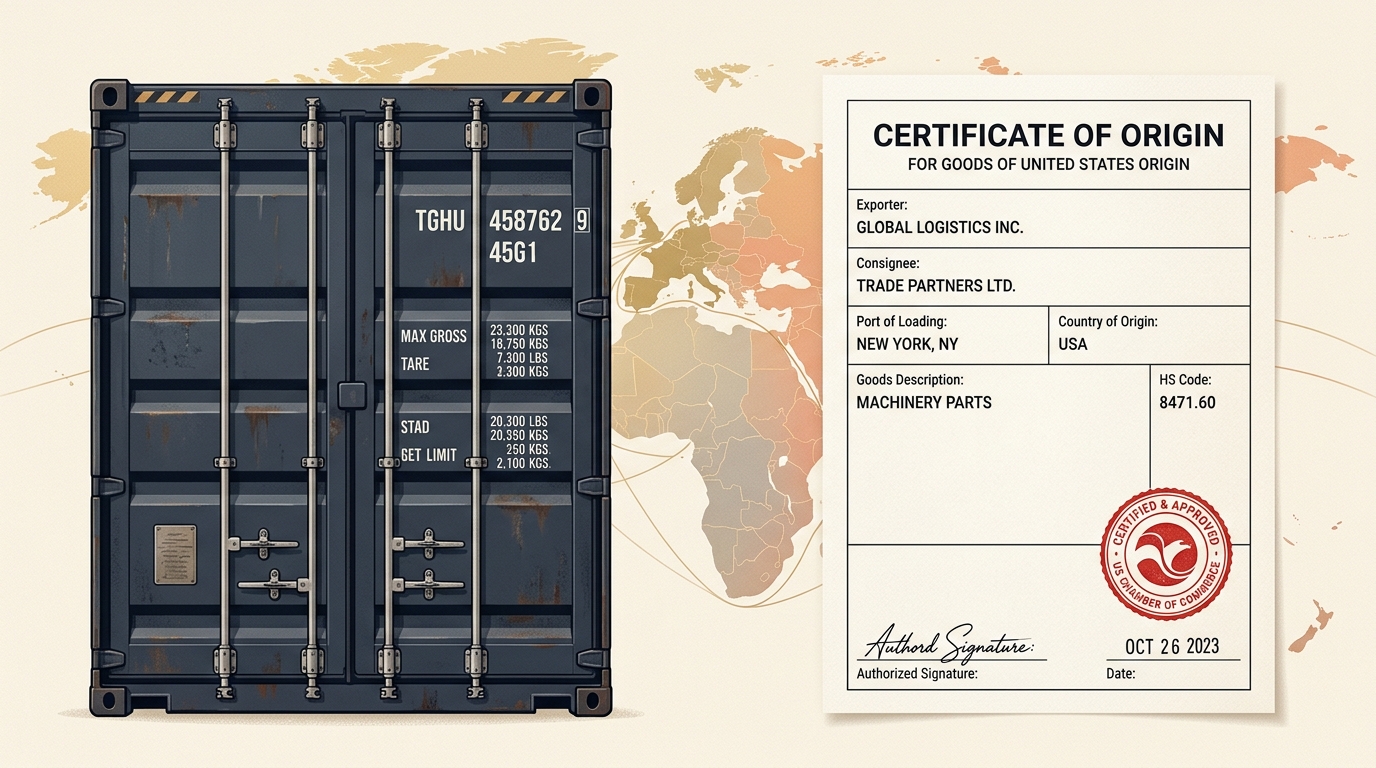
Your shipment just arrived at the port. Everything looks good — the cargo's packed, the commercial invoice is ready, the freight forwarder is on standby. Then customs puts a hold on it. Not because of the goods. Not because of the value. Because of one missing piece of paper: the Certificate of Origin. This happens more often than you'd think, and it costs exporters real money every single day. Whether you are shipping your first container or scaling an established export firm, this complete certificate of origin guide walks through everything you need to keep your cargo moving.
Think of It Like a Passport — for Your Products
A Certificate of Origin (COO) is an official trade document that certifies the specific country in which a good was manufactured, produced, or substantially transformed.
That's it. It's essentially a passport for your cargo. Just like your personal passport verifies your nationality when crossing borders, an authentic COO trade document verifies your product's economic nationality. And just like arriving at airport immigration without a passport stops your journey immediately, a missing or flawed COO can bring your shipment to a complete standstill at customs.
Customs authorities worldwide rely on the COO to answer three core questions: Where was this manufactured? Does this shipment qualify for preferential tariff reductions? And are these goods subject to specific trade restrictions, quotas, or anti-dumping duties? The accuracy of this single document determines whether your shipment clears port within hours or sits racked up in demurrage fees for weeks.
Why Does This Document Even Exist?
Countries do not treat all imports identically. For instance, an electronic component manufactured in Vietnam enters the European Union or United States under completely different tariff schedules and duty rates than the identical component assembled in a non-treaty nation. Because nations maintain distinct bilateral and multilateral trade pacts, customs border officers need reliable, tamper-evident proof of origin.
Without standardized origin documentation, border authorities would be forced to independently audit supply chains for millions of shipping containers daily — causing global commerce to grind to an immediate halt. The COO provides the universally recognized paper or digital trail that keeps global logistics moving smoothly.
Beyond standard import duties, national governments use origin data to:
- Enforce targeted international trade sanctions and embargoes
- Levy anti-dumping and countervailing duties against subsidized foreign goods
- Compile precise global trade statistics and balance-of-payment metrics
- Administer strict tariff-rate quotas (TRQs) on sensitive agricultural and industrial goods
In short: the Certificate of Origin is not bureaucratic busywork. It is the legal declaration that establishes the origin story of your products.
Who Actually Needs a Certificate of Origin?
If you produce, buy, sell, or transport physical goods across international borders, origin documentation directly impacts your balance sheet.
Exporters must provide the document because the vast majority of importing jurisdictions require verified origin before issuing customs release orders. Furthermore, major overseas buyers, retail conglomerates, and government procurement contracts legally mandate an authentic COO before releasing payment under Letters of Credit (LCs).
Importers rely heavily on the COO to legally claim zero or reduced duty rates under Free Trade Agreements. Failing to secure the correct COO from your overseas supplier means paying full standard Most-Favoured-Nation (MFN) tariffs out of pocket.
Freight Forwarders and Customs Brokers act as the frontline defence. They inspect documentation suites prior to vessel departure to catch missing or mismatched origin certificates before shipments trigger port holds and demurrage costs.
The Two Types of COO — and Why the Difference Really Matters
This is where trade compliance errors happen most often. There are two fundamentally different categories of Certificates of Origin, and using the wrong one can lead to immediate customs rejections or unexpected tariff bills.
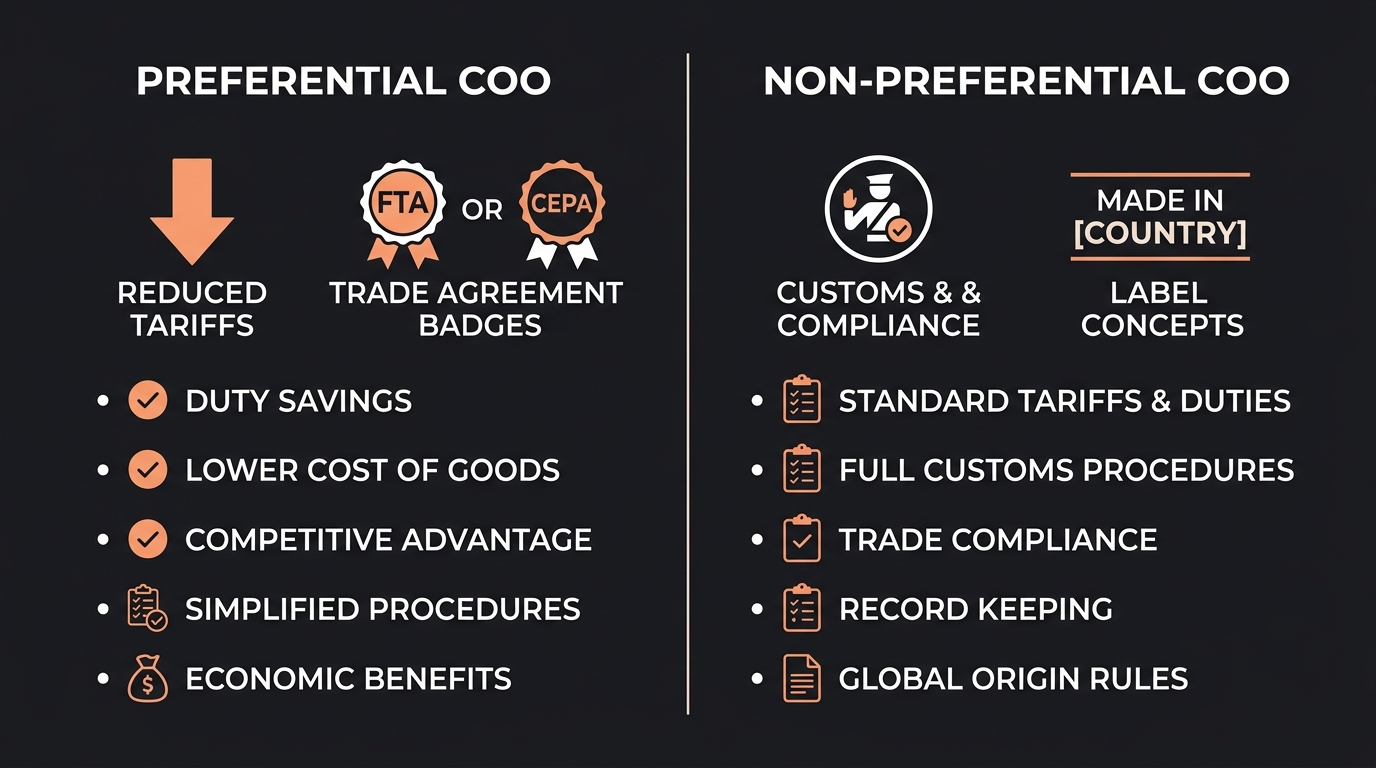
1. Preferential Certificate of Origin
A Preferential Certificate of Origin certifies that your goods satisfy the strict qualification rules of a specific Free Trade Agreement (FTA) or Economic Partnership Agreement, enabling them to clear customs at zero or substantially reduced tariff rates.
Key international examples include:
- USMCA (United States - Mexico - Canada Agreement): Replaced NAFTA. Eliminates a rigid standardized form in favour of a 9-element origin certification statement directly on the commercial invoice or standalone document.
- European Union FTAs: Utilizes EUR.1 Movement Certificates for formal bilateral agreements, origin declarations on commercial invoices for consignments under €6,000, or the self-certified Registered Exporter (REX) system.
- ASEAN Trade in Goods Agreement (ATIGA): Relies on the widely recognized "Form D" (and electronic e-Form D via the ASEAN Single Window), issued by authorized national bodies to unlock preferential intra-ASEAN tariffs.
- RCEP & CPTPP: Modern mega-regional trade pacts that combine government-issued origin certificates with accredited exporter self-declaration mechanisms across the Asia-Pacific region.
2. Non-Preferential Certificate of Origin
A Non-Preferential Certificate of Origin (often termed an "ordinary" or "standard" COO) certifies the origin of goods without conferring any special tariff discounts. It is required for baseline customs admissibility, quota administration, anti-dumping investigations, and general trade policy enforcement.
Non-preferential certificates are issued and stamped by local Chambers of Commerce or accredited trade bodies following documentary verification of commercial invoices and manufacturing records.
What's Actually on a Certificate of Origin?
While layout formats differ between Chambers of Commerce and government bodies, the core data fields are harmonized across international trade conventions:
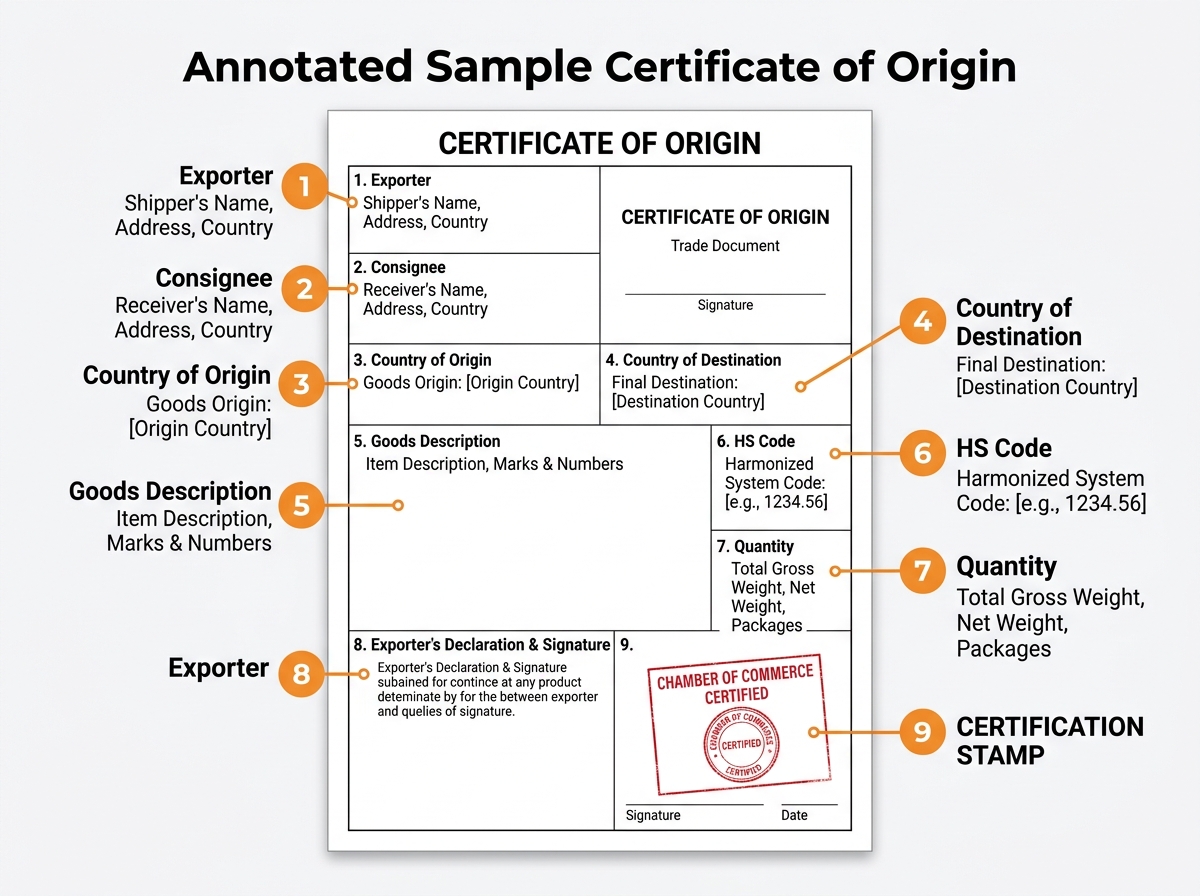
| Document Field | Data Required & Practical Compliance Rule |
|---|---|
| Exporter Name & Address | Full legal business name, registered physical address, and tax registration identifier matching commercial invoice. |
| Consignee Details | Buyer or receiver's full registered company name and destination address in the importing jurisdiction. |
| Country of Origin | The exact nation where goods were manufactured or substantially transformed (never a transit nation). |
| Country of Destination | Final destination country where customs entry will be lodged. |
| Transport Details | Modes of conveyance, vessel or flight number, port of loading, and port of discharge. |
| Goods Description | Precise commercial goods description; must match the commercial invoice word for word. |
| HS Tariff Code | Harmonized System 6-digit subheading classification (or 8-to-10 digit national tariff line). |
| Quantity & Weight | Net weight, gross weight, package counts, and container numbers matching the packing list exactly. |
| Invoice Reference | Commercial invoice number and invoice date covering the exact consignment. |
| Exporter Declaration | Authorized signature, corporate seal, and legal declaration affirming the truth of the statements. |
| Issuing Authority Certification | Official ink stamp, digital signature, or cryptographic QR verification code from the Chamber of Commerce. |
Who Issues a COO? (It Depends on Your Country)
Issuance authority differs depending on jurisdiction and whether the document is preferential or standard:
- Chambers of Commerce: The primary issuing bodies globally for non-preferential certificates. Operating under the World Chambers Federation (WCF) framework, national and regional chambers verify commercial evidence before affixing official stamps.
- Government Ministries and Customs: Many nations manage preferential origin issuance directly through state trade portals — such as DGFT in India, Enterprise Singapore, or the Ministry of International Trade and Industry (MITI) in Malaysia.
- Self-Certification by Exporters: Under modern Free Trade Agreements like USMCA, trusted registered exporters are empowered to self-certify origin statements on commercial invoices without third-party chamber fees or processing delays.
How to Get a Certificate of Origin (Step-by-Step)
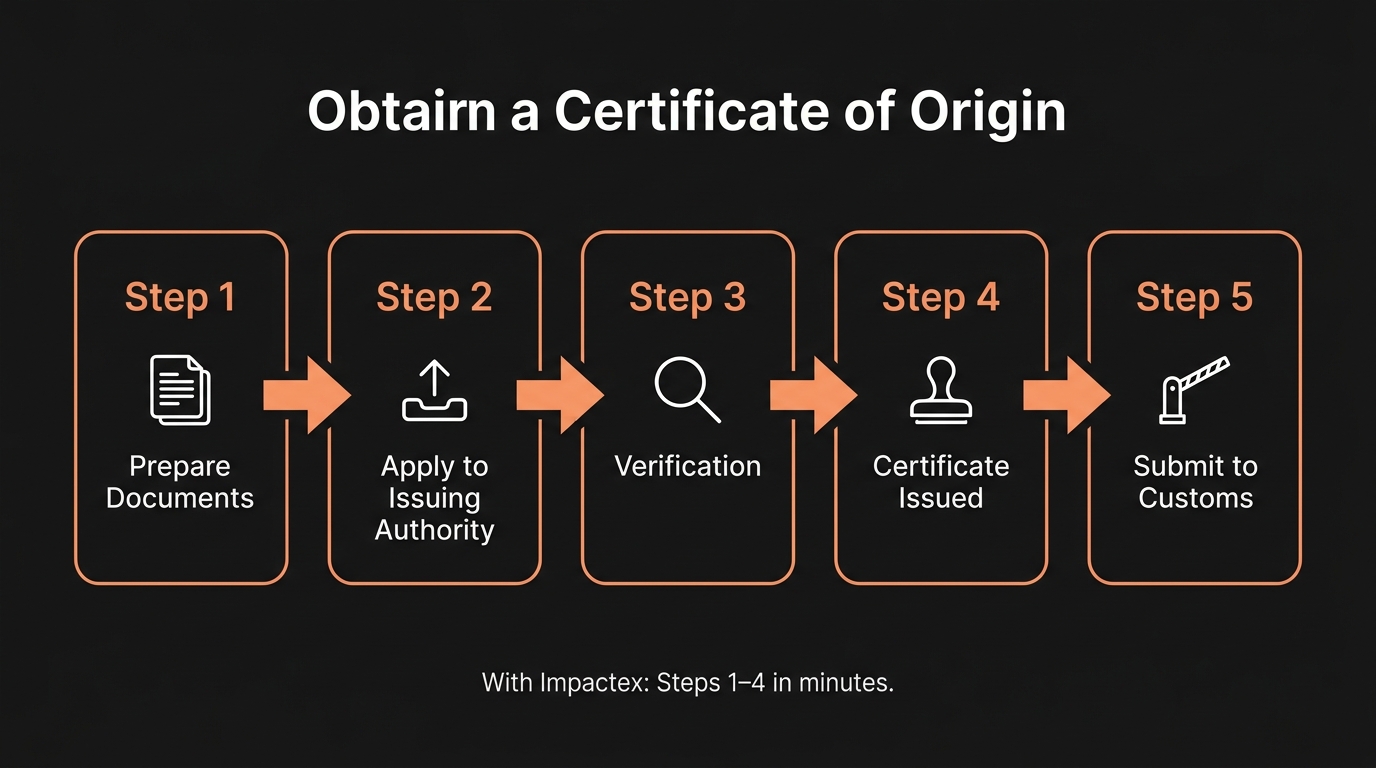
While specific administrative portals differ between jurisdictions, learning how to get a certificate of origin follows five standard stages:
- Prepare Core Supporting Documents: Compile your signed commercial invoice, packing list, bill of lading/airway bill, and bill of materials (BOM) or supplier declaration proving origin qualification.
- Identify the Required Certificate Type: Verify whether an active FTA applies to your product classification and destination country. If claiming tariff preferences, verify that the consignment meets the agreement rules of origin.
- Submit Application to Issuing Authority: Lodge the application via your local Chamber of Commerce digital portal or government trade window. Most authorities charge a standard processing fee ranging from $15 to $60 USD equivalent.
- Verification and Authentication: The issuing authority audits submitted proofs against product HS codes. Standard approval takes 24 to 72 hours, producing an embossed physical certificate or secure digital e-COO.
- Dispatch with Shipment Documentation: Transmit the e-COO or attach original stamped certificates to the shipping pouch for customs presentation at port of entry.
The Mistakes That Get COOs Rejected — and Cost Real Money
Customs audits catch hundreds of invalid origin claims every day. These six errors cause the vast majority of delays and financial penalties:
- Information Discrepancies Across Documents: Differences in piece counts, gross weights, or consignee legal names between your COO, invoice, and bill of lading trigger immediate red-channel inspections.
- Confusing Origin with Shipment Departure: Listing a transshipment hub (such as Singapore or Dubai) as the country of origin when the goods were manufactured elsewhere is illegal circumvention.
- Generic Product Descriptions: Using broad terms like "electronic parts" or "machinery" instead of exact commercial designations and 6-digit HS tariff subheadings invites customs queries.
- Unqualified Preferential Claims: Claiming zero-duty FTA rates without verifying substantial transformation or regional value content rules risks retroactive duty assessments and administrative fines.
- Incorrect Agreement Template: Submitting a general chamber certificate when the importing customs authority explicitly requires a treaty-specific movement certificate (e.g., EUR.1 or Form D).
- Expired Certificate Validity: Most preferential certificates remain valid for 12 months from issuance. Presenting an expired certificate results in mandatory Most-Favoured-Nation tariff payment.
Common Questions About Certificates of Origin
Frequently asked questions
Is a Certificate of Origin always required for international shipments?
Not universally. Mandatory requirements depend on the destination customs regulations, product classification, and whether tariff preferences under a trade agreement are being claimed. Many countries require a COO for all commercial consignments over a specific value threshold, while others only mandate one when preferential tariff rates are sought.
What is the practical difference between preferential and non-preferential COOs?
A preferential COO enables importers to claim reduced or zero import duties under a specific Free Trade Agreement, provided the goods meet strict origin qualification rules. A non-preferential COO provides official proof of origin for baseline customs clearance, quota compliance, and trade controls without granting tariff reductions.
Can an exporter self-certify a Certificate of Origin?
Under certain modern Free Trade Agreements, such as USMCA (North America) and the European Union REX framework, registered or approved exporters can self-certify origin statements directly on commercial invoices. However, standard non-preferential certificates almost always require formal certification by an accredited Chamber of Commerce.
How long is a Certificate of Origin legally valid?
Most preferential certificates under bilateral and multilateral FTAs (such as USMCA, EUR.1, and ASEAN Form D) remain valid for 12 months from the date of issuance. Consignments must clear customs before the certificate expiry date to benefit from preferential tariff rates.
What occurs if an error is detected on an issued COO during customs inspection?
Customs authorities typically detain the consignment, revoke duty preferences, and place the cargo on administrative hold. Importers must urgently secure an amended or replacement certificate from the issuing chamber or post cash security while awaiting documentation updates.
What does "substantial transformation" mean in origin determination?
Substantial transformation is the primary legal standard determining country of origin when raw materials or components originate from multiple nations. Goods are deemed to originate in the country where the final manufacturing process resulted in a new and distinct article of commerce, typically demonstrated by a change in HS tariff classification or a defined local value-add percentage.
A Certificate of Origin is one of those trade documents that seems simple until a single mismatch halts your container at customs. Getting your origin declarations right protects your margins, eliminates costly port demurrage fees, and ensures your overseas buyers enjoy the full tariff savings negotiated under international trade pacts.