Commercial Invoice for International Export: Free Template
A commercial invoice for international export is the first paper customs, your buyer and the bank all look at. If one field is wrong or vague, your cargo can sit at the port while people ask questions. This guide lists every field to include, shows the mistakes that cause delays, and gives you a free template to copy.
A commercial invoice is the bill that customs, banks and buyers all read
A commercial invoice for international export is the bill you issue to your overseas buyer when goods ship. It says what you sold, how many, at what price, in which currency and on what delivery terms.
Three people read it for three reasons. Customs reads it to work out duty and tax. The buyer reads it to pay you and to clear the goods. The bank reads it to release payment under a letter of credit or a collection.
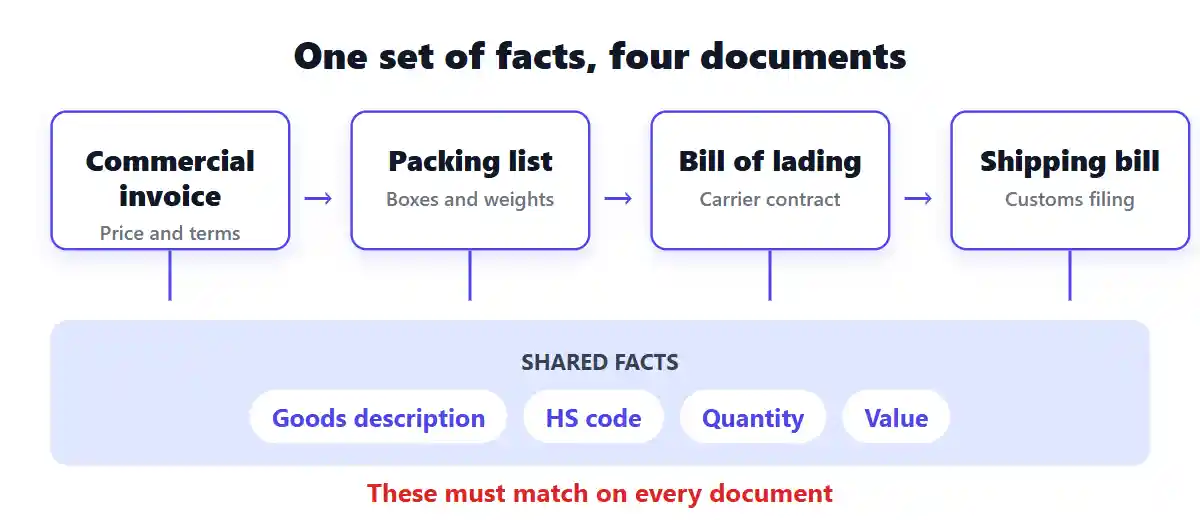
Other papers copy facts from it. The packing list, the bill of lading and the shipping bill (the customs filing you make in India) should all agree with it. If they do not, someone has to stop and ask why.
You issue the invoice on or after the shipping date, not before. Send it to your buyer with the other shipping papers. Keep a signed copy, because auditors and banks may ask for it years later.
A good commercial invoice for international export is plain and complete. It does not need fancy design. It needs the right facts, in the right place, with no gaps.
The commercial invoice for international export needs these 15 fields
There is no single global form. But most customs offices expect the same core facts. Use this table as your commercial invoice format, and check each row before you send.
| Field | What to write | Common mistake |
|---|---|---|
| Exporter details | Legal name, address, IEC and GSTIN | Using a trade name, not the registered name |
| Buyer details | Full name, address, tax or VAT ID | Missing the buyer's tax ID |
| Invoice number and date | A unique number and the issue date | Reusing a number, or an unclear date |
| PO or contract reference | The buyer's PO or contract number | Leaving it blank |
| Description of goods | Product, material, grade, use | Writing only "garments" or "spare parts" |
| HS code | 6 digits, or 8 digits for India | Copying an old code without checking |
| Country of origin | Where the goods were made | Writing the shipping country instead |
| Quantity and unit | Number plus unit, like 5,000 pcs | Different from the packing list |
| Unit price and total | Price per unit and line total | Maths errors in totals |
| Currency | ISO code like USD, EUR, GBP | Using only a symbol such as $ |
| Incoterm | Rule, named place, "Incoterms 2020" | Writing "FOB" with no place |
| Freight and insurance | Show each cost on its own line | Burying them inside the unit price |
| Payment terms | Advance, 30 days, LC, and so on | Terms that differ from the contract |
| Bank details | Bank name, account, SWIFT code | A typo in the SWIFT code |
| Declaration and signature | A true-and-correct statement, signed | No signature or no date |
That is the commercial invoice required fields list in one place. Some buyers ask for more, such as a bank stamp or a weight line. Ask your buyer early so you do not reprint at the last minute.
Write a goods description a customs officer can picture
Customs needs to know what the product is made of and what it is for. "Garments" tells them nothing. "Men's knitted T-shirts, 100% cotton, round neck" tells them almost everything.
Add the grade, size or model if it affects the duty. Use the same words on every document. If the packing list says "cotton tees" and the invoice says "T-shirts", someone will ask which is right.
Show price, freight and insurance on separate lines
On a commercial invoice for international export, put the unit price and the line total for each product. Then show freight and insurance on their own lines when the Incoterm makes you pay for them. Some customs offices add these costs to work out the value for duty.
Check the maths twice. A wrong total is the easiest error to avoid and one of the most common to see. Round the same way on every line.
Two fields cause most of the money problems: HS code and Incoterms
The HS code decides your duty rate
An HS code is a number that names your product in a global system. The World Customs Organization maintains it. Customs uses the code to set the duty rate, so the HS code on commercial invoice paperwork must be right.
The first 6 digits are the same worldwide. After that, each country adds its own digits. India uses an 8-digit ITC-HS code on export filings. Read our guide on what an HS code is for the full method.
The Incoterm decides who pays and who carries the risk
Incoterms are delivery rules published by the International Chamber of Commerce. The current set is Incoterms 2020, with 11 rules. On a commercial invoice for international export, show the rule, a named place and the edition.
For example, write "FOB Chennai, Incoterms 2020". Never write just "FOB". Here are five common rules for Incoterms on a commercial invoice.
| Rule | Who pays main freight | Risk passes when |
|---|---|---|
| EXW (Ex Works) | Buyer | Goods are ready at your premises |
| FOB (Free on Board) | Buyer | Goods are on board the ship at the port of loading |
| CIF (Cost, Insurance and Freight) | Seller | Goods are on board the ship at the port of loading |
| DAP (Delivered at Place) | Seller | Goods reach the named place, ready to unload |
| DDP (Delivered Duty Paid) | Seller | Goods reach the named place, import duty paid by seller |

FOB and CIF are meant for sea and inland waterway freight. For containers, many exporters use FCA or CIP instead, because the box is handed over before it reaches the ship.
Each destination adds a few rules of its own
United States
The US tariff schedule (HTS) uses 10 digits for import entry. Your buyer's broker will usually add the last digits. See US Customs and Border Protection for current import rules.
European Union
Importers in the EU need an EORI number, which is a customs registration number. Ask your buyer for it and print it on the commercial invoice for international export.
United Kingdom
The UK uses its own commodity codes and its own EORI number. Check the rules on GOV.UK before you ship.
UAE and GCC
For the UAE and GCC, your buyer usually needs an importer code. A commercial invoice for international export is often legalised or attested here, which means stamped by a chamber of commerce or other body. Confirm what your buyer needs.
India (outbound)
Print your IEC (Importer Exporter Code) and GSTIN. If you export under a Letter of Undertaking (LUT), which lets you export without paying IGST up front, add the LUT reference. Add the shipping bill number once it is filed. See DGFT for current export rules.
Copy this free commercial invoice template
This free commercial invoice template shows a commercial invoice for international export from India. The sample data is made up: Sample Exports Pvt Ltd, Tiruppur, selling cotton T-shirts to a buyer in Hamburg. Replace every sample value with your own.
Part 1: Invoice header
| Field | Sample entry |
|---|---|
| Exporter | Sample Exports Pvt Ltd, 12 Sample Road, Tiruppur, Tamil Nadu, India. IEC: 0000000000. GSTIN: 00AAAAA0000A1Z0 |
| Buyer | Muster Handels GmbH, 5 Beispielstrasse, 20095 Hamburg, Germany. EORI: DE0000000 |
| Invoice no | INV/2026/0001 |
| Date | 14 October 2026 |
| Buyer PO no | PO-7788 |
| Incoterm | FOB Chennai, Incoterms 2020 |
| Currency | EUR |
| Payment terms | 30 days from bill of lading date |
| Port of loading | Chennai, India |
| Port of discharge | Hamburg, Germany |
| Country of origin | India |
Part 2: Line items and totals
| No | Description | HS code | Qty | Unit | Unit price (EUR) | Amount (EUR) |
|---|---|---|---|---|---|---|
| 1 | Men's knitted T-shirts, 100% cotton, 180 gsm, round neck, sizes S to XL | 61091000 | 5,000 | pcs | 4.20 | 21,000.00 |
| 2 | (add more rows as needed) | |||||
| Goods total | 5,000 | pcs | 21,000.00 | |||
| Freight (if not FOB) | 0.00 | |||||
| Insurance (if not FOB) | 0.00 | |||||
| Invoice total | 21,000.00 |
Part 3: Declaration and signature
| Declaration | We declare that the goods are of Indian origin and the particulars are true and correct. |
| Bank details | Bank name, account number, SWIFT code |
| Signed by | Name, designation, signature, company stamp, date |
Copy these tables into your own file, or skip the typing. Impactex generates trade documents, suggests HS codes, and lets you sign a document so a buyer can verify it. The free plan covers ten documents a month. Create your free account.
How to read the sample invoice
In the sample, Sample Exports Pvt Ltd sells 5,000 cotton T-shirts at €4.20 each. That gives a goods total of 21,000.00 EUR. The Incoterm is FOB Chennai, so the buyer pays the main freight and the freight and insurance lines stay at zero.
The HS code 61091000 is shown only as an example of an 8-digit Indian code. Always check the code for your own product. Every figure, name and number in the sample is invented.
If you export under a Letter of Undertaking, add the LUT reference under the header. If you pay IGST and claim a refund instead, state that. Your accountant or customs broker can tell you which route fits your business.
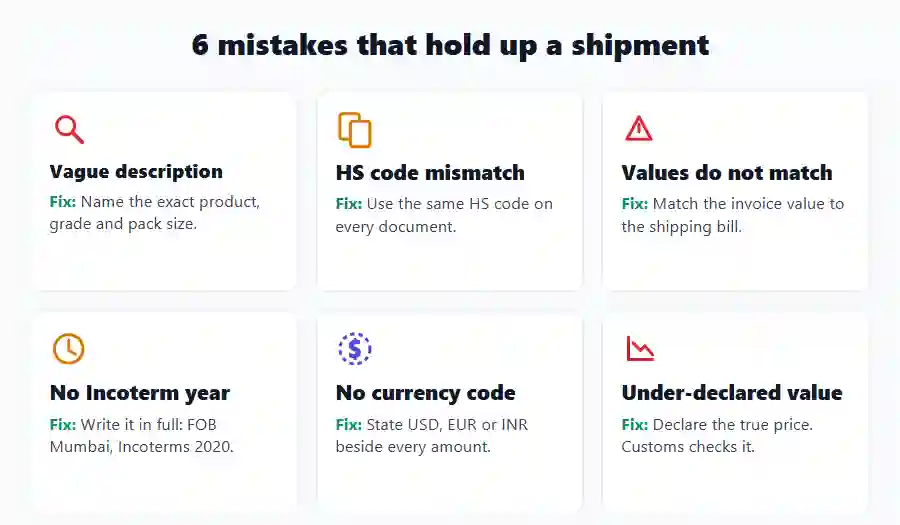
Six mistakes that hold up a shipment
Most delays come from a small set of errors. Each one is cheap to avoid when you check the commercial invoice for international export before it leaves your office.
- A vague description. "Garments" or "parts" invites an inspection. Write the product, material, grade and use.
- An HS code that does not fit the goods. The buyer's broker may enter a different code, and the two will clash. Check the code against the official schedule before you print it.
- Values that differ across documents. Quantities and totals must match the packing list and the bill of lading. Enter them once and reuse them.
- An undated or wrong Incoterm. Write the rule, the named place and "Incoterms 2020". Match what the contract says.
- A missing currency code. A bare "$" could be several currencies. Always write USD, EUR, GBP or the right ISO code.
- An under-declared value. Customs may compare your price with market prices. Consequences differ by country, so declare the true transaction value.
A 6-step checklist before you send the invoice
Run through these six steps for every commercial invoice for international export. It takes about ten minutes and saves days of delay.
- Check the buyer's name, address and tax ID against the contract.
- Confirm each description, HS code and quantity.
- Re-add the totals and check the currency code.
- Write the Incoterm with a named place and "Incoterms 2020".
- Compare the invoice with the packing list and shipping bill.
- Sign and date it, then send a copy to your freight forwarder.
Common questions
what is a commercial invoice in export
It is the bill the exporter issues to the overseas buyer when goods ship. It lists the goods, price, currency and delivery terms. Customs uses it to assess duty.
is a commercial invoice the same as a customs invoice
Often yes. Many countries accept the commercial invoice as the customs invoice. A few ask for their own form or extra details, so check with your buyer's broker.
what HS code should I put on a commercial invoice
Use the code that matches your product, with at least 6 digits. Indian exporters file an 8-digit ITC-HS code. Check it against the official schedule, not an old invoice.
which Incoterm should I use for sea freight
FOB and CIF are the classic sea freight rules. For containers, many exporters use FCA or CIP. Write the rule, a named place and Incoterms 2020.
do I need a commercial invoice for samples
Yes, samples crossing a border still need an invoice. If they have no commercial value, say so clearly and give a fair value for customs. Check the destination's rules for samples.
how many copies of a commercial invoice do I need
This depends on the buyer, the bank and the destination. Ask your freight forwarder and your buyer before you print. Keep a signed copy for your own records.
does a commercial invoice need a signature or stamp
A signature and date are standard. Some destinations or banks also want a company stamp or attestation. Confirm this with your buyer before shipping.