Incoterms 2020 Explained: The Complete Guide for Exporters
Every international sale involves a quiet but critical question: who pays for what, and when does risk change hands? Get this wrong, and you could find yourself liable for damaged cargo sitting in a port 8,000 km away. Incoterms 2020 - the latest edition of the International Commercial Terms published by the International Chamber of Commerce (ICC) - is the universal shorthand that settles this in three letters.
This guide has all 11 Incoterms explained in plain language — what each one means for your costs and risk as an exporter, how to pick the right term, and the common mistakes to avoid. Whether you are weighing FOB vs CIF for a sea shipment or considering DDP for a high-value buyer, this is the reference to settle it.
What Are Incoterms?
Incoterms are a set of 11 standardised trade rules published by the ICC that define the responsibilities of buyers and sellers in international transactions. They answer three questions for every shipment:
- Who arranges and pays for transport, insurance and customs clearance?
- At what point does the risk of loss or damage transfer from seller to buyer?
- Who handles export and import formalities?
They are not law. They are a contractual shorthand — they apply only when both parties agree to them in their contract. But they are so widely recognised that customs authorities, banks (especially for Letters of Credit), insurers and freight forwarders all expect to see them on your documents.
Why Incoterms Matter for Exporters
Imagine you quote a buyer in Hamburg "$12,000 CIF". That three-letter code commits you to paying for ocean freight and marine insurance all the way to the destination port. If you meant to quote FOB — where the buyer takes over once goods are on board the vessel — you have just absorbed ₹2–4 lakh in freight and insurance you did not budget for.
Beyond cost, the Incoterm decides:
- Your liability window. Under EXW, risk transfers the moment goods leave your factory. Under DDP, you carry risk until they reach the buyer's warehouse — including customs clearance in a country whose regulations you may not know.
- Insurance obligations. CIF and CIP are the only two terms that require the seller to buy cargo insurance. Under FOB or CFR, insurance is the buyer's problem — but if they skip it, uninsured cargo is still your commercial relationship on the line.
- Document consistency. The Incoterm on your Commercial Invoice must match the one on the Proforma Invoice, the Bill of Lading and the Purchase Order. A mismatch is a red flag for customs, banks and LC negotiations.
- Pricing strategy. Quoting FOB lets you compete purely on product cost. Quoting CIF or DDP lets you offer a landed-cost price — more convenient for the buyer, but you need reliable freight quotes to protect your margin.
All 11 Incoterms 2020 at a Glance
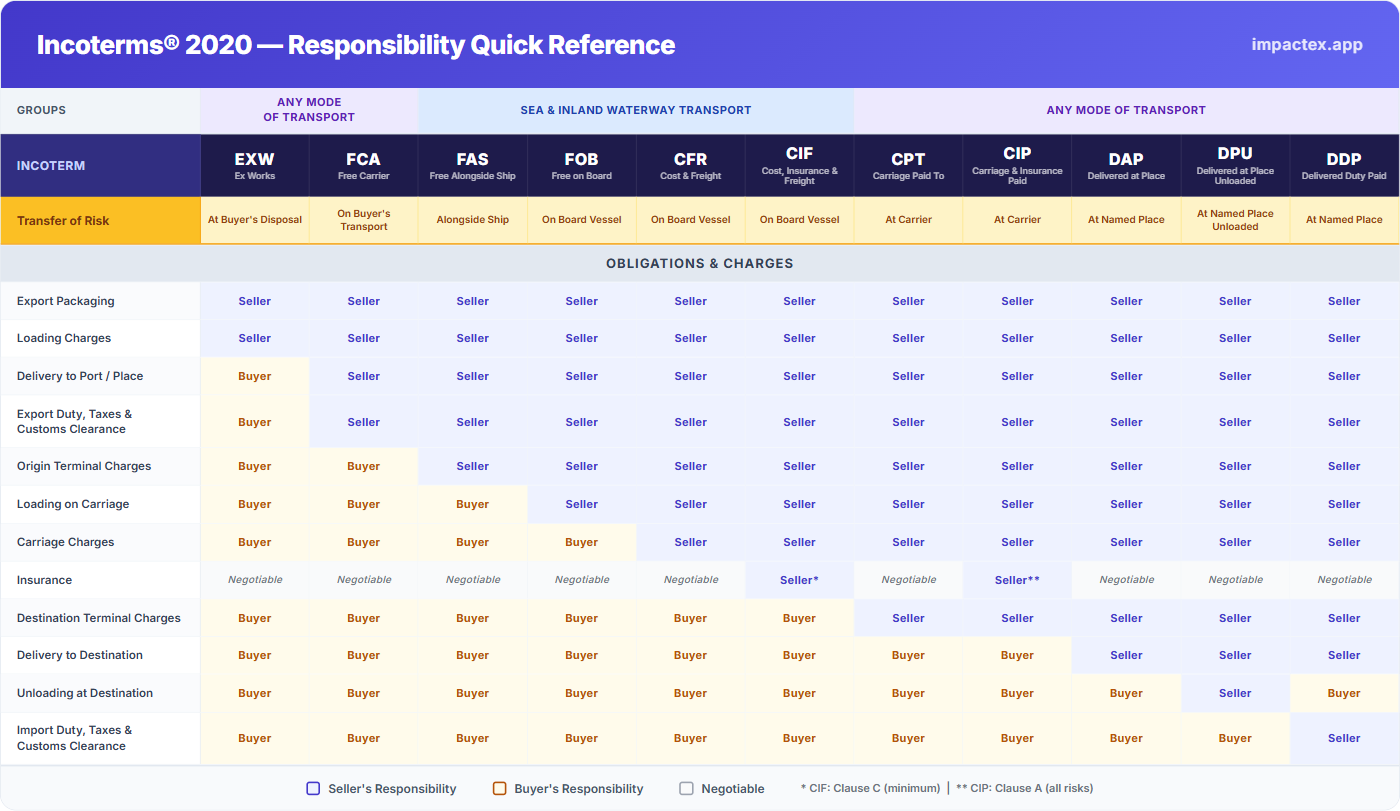
The 11 terms fall into four groups named by their first letter. The groups roughly track how much responsibility the seller takes on — from almost none (E) to everything (D).
| Group | Term | Full Name | Transport Mode | Risk Transfers To Buyer At |
|---|---|---|---|---|
| E | EXW | Ex Works | Any | Seller's premises |
| F | FCA | Free Carrier | Any | Named carrier/place |
| F | FAS | Free Alongside Ship | Sea only | Alongside the vessel |
| F | FOB | Free on Board | Sea only | On board the vessel |
| C | CFR | Cost and Freight | Sea only | On board the vessel |
| C | CIF | Cost, Insurance and Freight | Sea only | On board the vessel |
| C | CPT | Carriage Paid To | Any | First carrier |
| C | CIP | Carriage and Insurance Paid To | Any | First carrier |
| D | DAP | Delivered at Place | Any | Destination, not unloaded |
| D | DPU | Delivered at Place Unloaded | Any | Destination, unloaded |
| D | DDP | Delivered Duty Paid | Any | Destination, duties paid |
Group E — Departure: EXW
EXW (Ex Works)
The seller's minimum obligation. You make the goods available at your premises (factory, warehouse). The buyer arranges everything: loading, inland transport, export clearance, freight, import clearance.
In practice, EXW is rarely suitable for international sales from India. Indian customs regulations require the exporter of record to handle export clearance. A foreign buyer cannot file a Shipping Bill on your behalf. If your buyer insists on EXW, FCA (your premises) achieves the same result while keeping export formalities where they legally belong — with you.
Group F — Main Carriage Unpaid
The seller delivers the goods to a carrier or vessel nominated by the buyer. The buyer pays for main transport.
FCA (Free Carrier)
You deliver goods to a carrier at a named place — your factory, a container freight station, or an inland container depot. You handle export clearance. Risk passes when the carrier takes charge.
FCA is the ICC's recommended replacement for both EXW (when named place is the seller's premises) and FOB (for containerised cargo). It also has a useful 2020 addition: the buyer can instruct their carrier to issue a Bill of Lading with an on-board notation to the seller, which matters for LC compliance.
FOB (Free on Board)
The workhorse of Indian exports. The FOB meaning is straightforward: you deliver the goods on board the vessel at the named port of shipment. You handle export clearance and bear all costs until the goods cross the ship's rail. The buyer arranges and pays for ocean freight and insurance.
FOB is popular because it gives both sides a clean split: you control the domestic leg (factory to port, customs), the buyer controls the international leg. If you are new to exporting, FOB is usually the safest starting point.
FAS (Free Alongside Ship)
You deliver goods alongside the vessel (on the quay or a barge) at the named port. Risk transfers at that point. Rarely used for containerised cargo — it is more common for bulk commodities where goods are loaded by crane directly.
Group C — Main Carriage Paid
The seller pays for main carriage but does not bear the risk during it. This is the non-obvious part: cost and risk split at different points. You pay the freight, but the buyer bears the risk from the moment the goods are on board (CFR/CIF) or with the first carrier (CPT/CIP).
CFR (Cost and Freight)
Like FOB, but you also pay for ocean freight to the destination port. Risk still passes when the goods are on board at the origin port. The buyer needs to arrange insurance themselves.
CIF (Cost, Insurance and Freight)
The CIF meaning builds on CFR: same arrangement, plus you must procure marine cargo insurance. The insurance must cover at least 110% of the contract value (Institute Cargo Clauses C — the minimum). CIF is the second most common term for Indian sea exports after FOB.
CPT (Carriage Paid To)
The multimodal equivalent of CFR. You pay freight to the destination, risk passes at the first carrier. Works for air, road, rail or combined transport — anywhere FOB does not technically fit.
CIP (Carriage and Insurance Paid To)
Same as CPT, plus insurance. A key 2020 change: CIP now requires Institute Cargo Clauses A (all risks), not the minimum Clause C that CIF requires. This makes CIP more expensive but more protective than CIF.
Group D — Arrival: Delivered Terms
The seller bears all costs and risks until the goods arrive at the agreed destination. These are the most seller-responsible terms.
DAP (Delivered at Place)
You deliver goods ready for unloading at the named destination. Import clearance and duties are the buyer's responsibility. DAP is useful when you want to offer a landed price without taking on the buyer's import formalities.
DPU (Delivered at Place Unloaded)
New in 2020 (replaced DAT). You deliver and unload the goods at the named destination. This is the only Incoterm where the seller is responsible for unloading. Practical for projects where you are supplying and installing equipment.
DDP (Delivered Duty Paid)
The seller's maximum obligation. You handle everything — transport, insurance, export clearance, import clearance and import duties — right to the buyer's door. The buyer only unloads.
Which Incoterm Should You Choose?
There is no universally "best" Incoterm. The right choice depends on your experience, your relationship with the buyer, and how much control you want over the logistics chain.
| If you want to... | Use | Why |
|---|---|---|
| Keep it simple — just get goods to the port | FOB | Clean split. You handle the domestic side, the buyer handles the rest. |
| Offer a landed-cost price (sea) | CIF | Buyer sees one number. You need reliable freight and insurance quotes. |
| Ship by air, road or multimodal | CPT or CIP | The multimodal equivalents of CFR/CIF. Technically correct where FOB is not. |
| Deliver to the buyer's warehouse | DAP | You control the whole chain but the buyer handles import clearance. |
| Compete on convenience (small, high-value goods) | DDP | Buyer does nothing. High effort and risk for you — know the destination country's rules first. |
| Let the buyer arrange everything | FCA | Better than EXW for Indian exporters because you keep export clearance. |
Common Mistakes Exporters Make with Incoterms
- Using FOB for air freight. FOB is a sea-only term. For air shipments, use FCA (airport) or CPT. Banks processing an LC may flag this inconsistency.
- Confusing cost and risk in C-group terms. Under CIF, you pay for freight and insurance, but risk passes at the origin port. If cargo is damaged mid-ocean, the claim is the buyer's to file — you have already fulfilled your obligation.
- Quoting EXW to avoid hassle. Indian exporters must handle export customs clearance. A foreign buyer cannot file your Shipping Bill. EXW creates a legal impossibility. Use FCA instead.
- Omitting the named place. "FOB" alone is incomplete. It should be "FOB Mumbai Port" or "CIF Hamburg". Without the place, there is no defined point for risk transfer.
- Mismatched terms across documents. If your Proforma says FOB and your Commercial Invoice says CIF, customs and banks will ask questions. Keep every document aligned.
- Using old editions. Incoterms 2010 terms like DAT no longer exist (it is DPU now). Specify "Incoterms 2020" on your contract and invoice.
Incoterms and Your Export Documents
The Incoterm you agree to flows through nearly every document in a shipment. If you are unfamiliar with any of these, see our guides to the Commercial Invoice, the Bill of Lading, the Certificate of Origin and HS codes:
| Document | Where the Incoterm Appears |
|---|---|
| Proforma Invoice | Next to the quoted price — this is where the buyer first sees your terms. |
| Commercial Invoice | The delivery terms field. Must match the proforma exactly. |
| Bill of Lading | Freight indication: "Freight Prepaid" (C/D terms) or "Freight Collect" (F terms). |
| Purchase Order | The buyer's acceptance of your terms. |
| Sales Contract | The governing clause. Should state "Incoterms 2020" explicitly. |
| Letter of Credit | The LC will specify the Incoterm. A mismatch between the LC and the invoice is a discrepancy. |
| Certificate of Origin | Not directly, but the FOB value is used for customs valuation in many countries. |
Consistency matters. If you use Impactex, the Incoterm field on your Proforma Invoice, Commercial Invoice and other documents keeps this aligned across the shipment.
What Changed in Incoterms 2020?
If you were used to Incoterms 2010, the main changes to know:
- DAT → DPU. "Delivered at Terminal" was renamed "Delivered at Place Unloaded" to make clear the destination can be any place, not just a terminal.
- CIP insurance raised to Clause A (all risks). CIF stays at Clause C. This is the first time the two insurance terms have required different coverage levels.
- FCA on-board Bill of Lading. Buyers can now instruct their carrier to issue a B/L with an on-board notation back to the seller — solving a long-standing problem with LC-financed container shipments.
- Own-transport options in FCA, DAP, DPU, DDP. The seller (or buyer) can now use their own transport rather than contracting a third-party carrier.
- Security-related requirements. Allocation of security clearance costs is now explicitly addressed in each term.
Frequently Asked Questions
Are Incoterms legally binding?
Only when incorporated into a contract between buyer and seller. They are not law — they are standard terms published by the ICC that parties can choose to adopt. Once adopted, they define the obligations each party has agreed to.
Can I use Incoterms 2010 terms in 2026?
Technically, yes — you can reference any edition if both parties agree. But Incoterms 2020 is the current edition, and some 2010 terms (DAT) no longer exist. Banks, insurers and customs authorities expect the current edition. Always state "Incoterms 2020" on your documents.
What is the difference between FOB and CIF?
Under FOB, risk and cost transfer when goods are loaded on the vessel at the origin port. The buyer arranges and pays for ocean freight and insurance. Under CIF, risk still transfers at the origin port, but the seller pays for freight and minimum insurance to the destination port. The price difference is the freight and insurance the seller absorbs.
Which Incoterm is best for a new exporter from India?
FOB (named port) is the most common starting point. You handle what you know — production, inland transport, export clearance — and the buyer handles international freight. It keeps your cost exposure predictable and avoids the complexity of destination-country logistics.
Do Incoterms apply to domestic trade?
Incoterms 2020 can be used for both domestic and international sales, though they are designed primarily for cross-border trade. For domestic transactions within India, the terms still work but some (like import clearance obligations) become irrelevant.
Why should I avoid EXW as an Indian exporter?
Indian customs law requires the exporter to handle export clearance, including filing the Shipping Bill. Under EXW, this responsibility falls on the buyer — who, as a foreign entity, cannot legally do it in India. FCA (seller's premises) achieves the same commercial outcome while keeping export formalities with you.